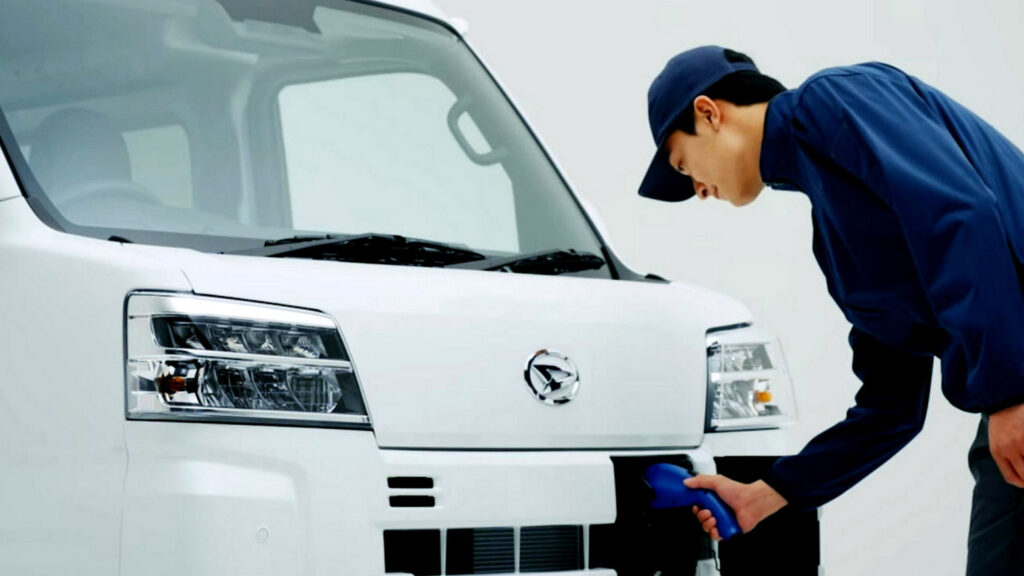
- Toyota and Daihatsu launch electric kei vans in Japan.
- Powertrain delivers 63 hp and up to 160 miles of range.
- Prices are nearly triple those of gasoline equivalents.
After years of delays and development setbacks, Japan’s long-awaited electric kei vans from Toyota, Daihatsu, and Suzuki have officially made the leap from concept to production.
The three brands have confirmed the market launch of their collaborative battery-powered van lineup: the Toyota Pixis Van BEV, the Daihatsu e-Hijet Cargo, and the Daihatsu e-Atrai RS. Suzuki’s equivalent, the nearly identical e-Every, is also on the way. These production models arrive almost three years after the original trio debuted in prototype form back in 2023.
More: Daihatsu Hijet Is Available In 26 Configurations, Including Tiny Dump Trucks
On the outside, these new zero-emission vans mirror their combustion-engine siblings, which have been on sale since 2021. The main visual clue is the addition of a charging port on the front bumper.
Between the Toyota and Daihatsu versions, the only visible difference lies in the badges. The e-Atrai RS, Daihatsu’s more passenger-friendly variant, is sold exclusively in a single RS trim. It features black steel wheels, color-matched accents, chrome detailing, and power sliding doors on both sides.
Inside, the highlight is the new shifter, sourced from other Toyota models such as the Prius. Equipment includes heated front seats and auto A/C for greater efficiency, a USB port, an AC 100V outlet for powering external devices, and an enhanced preventing safety system called Smart Assist.
Practicality remains central, with an overhead compartment and smart storage solutions integrated throughout the cabin. More importantly, the move to electric power leaves both the cargo space and the 350 kg (772 lb) maximum load capacity untouched.
Fully Electric Powertrain
The kei vans are identical under the skin, riding on the Daihatsu New Global Architecture (DNGA) platform with a new powertrain developed jointly by Suzuki, Daihatsu and Toyota.
More: Daihatsu Built A Sleeper Kei Car With A Roll Cage And It’s Headed For Sale
A single rear-mounted electric motor (e-axle) produces 63 hp (47 kW / 64 PS) and 126 Nm (93 lb-ft) of torque. That matches the output of the turbocharged 660cc three-cylinder gasoline engine, with an added 35 Nm (26 lb-ft) of torque.
The floor-mounted lithium-ion battery pack has a capacity of 36.6 kWh, allowing a WLTC range of 160 miles (257 km) between charges. This is 36 miles (57 km) more than the targeted figure during development, and should be enough for urban deliveries. It is also slightly better than the 152 mile (245 km) range of the Honda N-Van e: which is their main competitor.
A full charge is completed in around 6 hours from a standard 6 kW outlet, while a 50 kW fast charger will take it to 80% in 50 minutes. Finally, the EVs are compatible with Vehicle-to-Home (V2H) technology.
More: For $8,500, Nissan Will Sell You A Kei Truck That Still Thinks It’s The ’90s
Engineers have also applied BEV-specific structural reinforcements to the chassis, promising better handling thanks to the lower center of gravity, and improved ride comfort thanks to the new trailing-link rigid-axle rear suspension and the optimised spring rates.
A Premium for Zero Emissions
The jump to electric doesn’t come cheap. Both the Toyota Pixis Van BEV and Daihatsu e-Hijet Cargo start at ¥3,146,000 (about $20,300 at current exchange rates) in Japan, nearly three times the cost of their entry-level gasoline counterparts, which begin at ¥1,100,000 (roughly $7,100). The Daihatsu e-Atrai RS comes in higher still, starting from ¥3,465,000 ($22,400).
Production will take place at Daihatsu’s plant in Nakatsu, Japan. Toyota is targeting 50 sales per month, while Daihatsu expects to move around 300 units monthly.